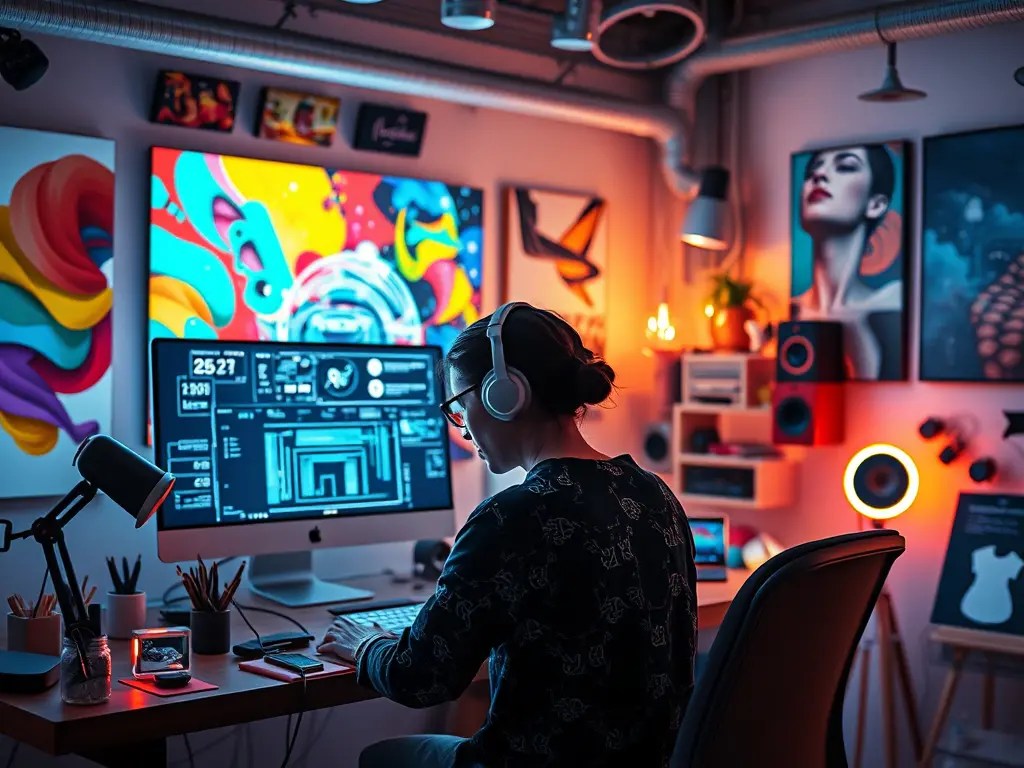
Let’s take a deep dive into AI and creativity, exploring its nuances from multiple angles: we will examine how artificial intelligence not only assists artists in generating innovative ideas but also challenges traditional perceptions of creativity by pushing the boundaries of artistic expression. By analyzing the collaboration between human artists and AI systems, we can uncover the various methods through which technology enhances the creative process, enabling new forms of art that were once unimaginable. Furthermore, we will investigate the ethical implications of using AI in creative fields and how it reshapes our understanding of authorship and originality in the digital age.
1. Defining Creativity in the Age of AI
Creativity is often seen as the ability to generate original, meaningful ideas. Traditional human creativity involves intuition, emotion, experience, and the ability to think beyond patterns. AI, on the other hand, thrives on pattern recognition, data processing, and probabilistic generation. The real question is: can AI truly “create,” or is it simply remixing existing data?
2. AI as a Creative Assistant
AI excels at assisting creativity rather than replacing it. Some ways AI boosts human creativity:
- Idea Generation: Writers, artists, and designers use AI tools for brainstorming, overcoming creative blocks, and refining concepts, helping them to explore new avenues of creativity and gain fresh perspectives on their projects, ultimately enhancing the quality and originality of their work.
- Automated Execution: AI can quickly generate drafts or visuals that creators can build upon, streamlining the creative process and allowing for more efficient workflows. This not only saves valuable time but also opens up new avenues for creativity, enabling creators to focus on refining and perfecting their ideas rather than starting from scratch.
- Personalized Recommendations: AI analyzes user preferences based on previous interactions and behavior to suggest tailored content, aiding in discovery, enhancing user experience, and providing inspiration effectively.
3. AI’s Role in Different Creative Fields
Let’s break down AI’s influence across major creative industries:
Visual Arts
AI-driven platforms like DALL·E and Stable Diffusion can generate striking digital art based on textual prompts. Artists now use AI to assist in concept design, refine sketches, or explore new aesthetic styles. However, critics argue that AI-generated art lacks true emotional depth and originality.
Music Composition
AI can compose melodies, harmonize notes, and even mimic the style of legendary musicians. Tools like Amper Music and AIVA help musicians craft soundtracks in seconds. Some artists integrate AI-generated elements while adding human interpretation and emotion to make music truly resonate.
Writing & Storytelling
AI-powered tools like GPT-4 (and beyond) generate poetry, short stories, and even full novels. Some use AI to draft scripts, write marketing copy, or assist with translation. The limitation? AI lacks genuine human experiences and emotions, making purely AI-generated narratives less immersive.
Film & Animation
AI is revolutionizing visual effects, deepfakes, and even scriptwriting assistance. Some filmmakers use AI to enhance CGI, generate synthetic actors, or automate tedious editing processes.
Fashion & Design
AI influences fashion by predicting trends, generating designs, and automating the tailoring process. Brands use AI to create virtual clothing prototypes and recommend personalized styles.
4. The Ethical Dilemmas of AI Creativity
As AI becomes more sophisticated, ethical concerns arise:
- Copyright & Ownership: Who owns AI-generated creations? Should the AI’s creator or the person who inputs the prompts hold the rights? This question raises complex legal and ethical considerations, as the implications of ownership can affect how such works are used, shared, and monetized in various industries, including art, music, and literature. Furthermore, as AI technology continues to evolve, establishing clear guidelines and regulations regarding copyright and ownership will be crucial in navigating the future landscape of creative content generation.
- Plagiarism & Originality: AI can unintentionally recreate elements of copyrighted works, leading to a multitude of legal and ethical debates that challenge the very foundation of intellectual property rights and raise significant concerns among creators and users alike. The implications of these issues have sparked discussions about the responsibilities of developers and the rights of original authors in today’s rapidly evolving digital landscape.
- Job Displacement: As AI becomes more capable with advancements in technology and machine learning, will human artists, designers, and writers inevitably lose opportunities and face challenges in finding work in creative fields?
- Bias & Representation: AI models are trained on the vast pool of existing data, which often reflects historical and societal biases. This means that rather than breaking creative barriers and advancing innovation, these models may inadvertently reinforce stereotypes and perpetuate existing inequalities in the data. Consequently, it is crucial for developers to actively work towards minimizing these biases in order to promote a more equitable and inclusive application of AI technology.
5. AI vs. Human Creativity: The Fundamental Difference
Even though AI can generate astonishing outputs, human creativity is deeply tied to emotion, lived experience, cultural context, and imagination—things AI does not inherently possess. AI lacks self-awareness, passion, and personal motivation, making purely AI-driven creativity feel somewhat hollow. The magic lies in collaboration—where AI enhances human ideas rather than replaces them.
6. The Future: AI as a Creative Partner
Instead of fearing AI’s rise, many believe the future will embrace AI-assisted creativity, where humans and machines co-create:
- AI as a Muse: Generating innovative ideas, enhancing inspiration, and pushing creative boundaries to explore new artistic dimensions and possibilities.
- AI as an Editor: Refining raw creative output through various stages of analysis and enhancement, ensuring clarity, coherence, and the overall quality of the final product.
- AI as a Co-creator: Working alongside humans to craft immersive, unique works that inspire creativity, push boundaries, and explore uncharted territories of artistic expression, ultimately enriching the collaborative process of creation.
Final Thoughts
AI and creativity are not opposing forces but rather complementary ones that, when harmonized, can lead to remarkable innovations. The key will be finding the balance—embracing AI’s efficiency while preserving human originality, intuition, and soul. This synergy allows us to leverage AI’s advanced analytical capabilities to enhance creative processes, inspiring artists, writers, and thinkers to explore new horizons. As we navigate this evolving landscape, it’s essential to acknowledge that while machines can generate ideas and optimize workflows, it is the uniquely human touch that infuses art and narrative with emotion and depth, ensuring that creativity remains a profoundly personal experience. Through collaboration between technology and human insight, we can unlock endless possibilities that enrich our cultural and artistic expressions.
 Ignite and Achieve