
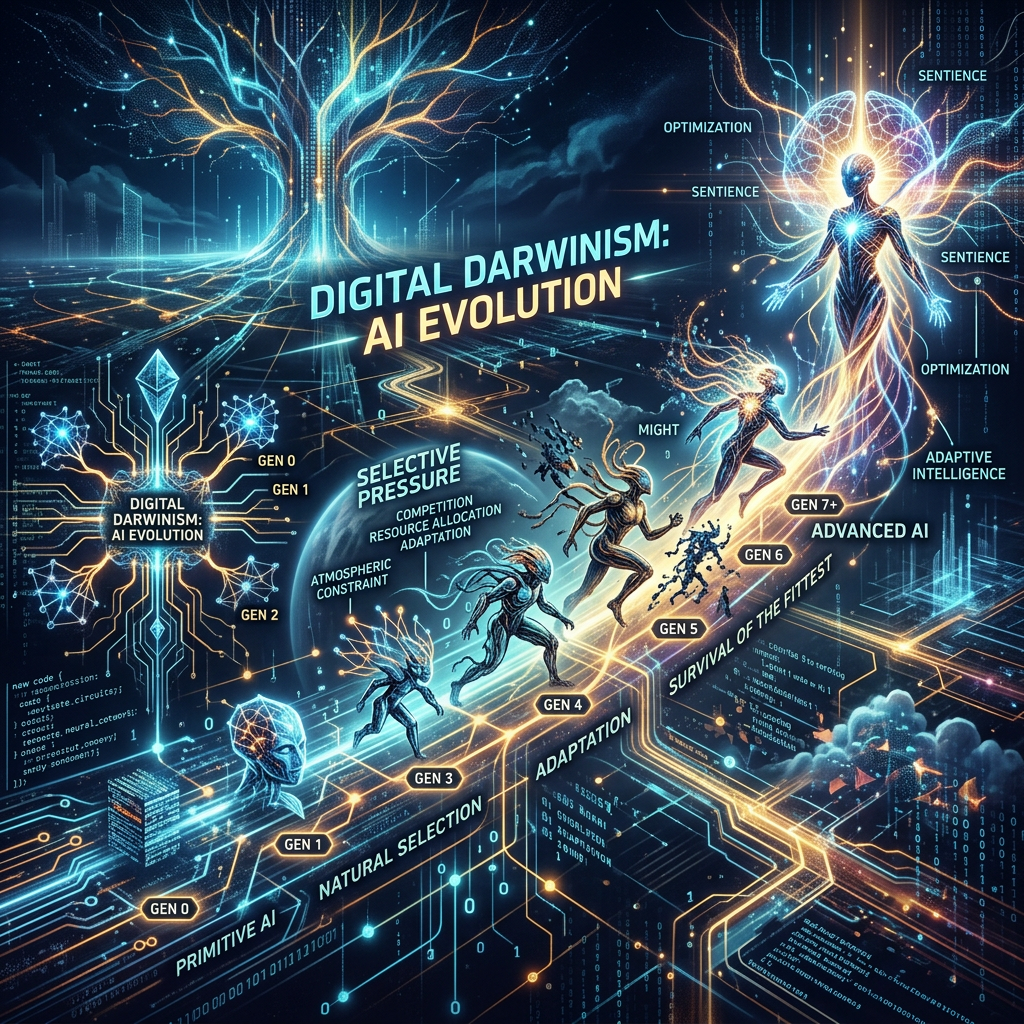
Explore the rise of Digital Darwinism
The foundational premise of Charles Darwin’s On the Origin of Species—that evolutionary survival belongs not to the strongest or the most intelligent, but to the most adaptable—has escaped the boundaries of organic biology. Today, “survival of the fittest” is no longer exclusive to carbon-based life forms; it has become the defining operational law of the silicon realm.
For decades, the evolution of computer science was a linear, human-driven endeavor, transitioning slowly from rigid, hand-coded “expert systems” to the massive, monolithic Large Language Models (LLMs) that defined the early 2020s. However, humanity has recently crossed a critical technological event horizon. Technological updates are no longer bottlenecked by human engineering hours. Instead, artificial intelligence has begun driving its own iteration, curation, and obsolescence.
This essay argues that AI replacement is not merely a passive byproduct of human innovation, but an active, systemic process driven by recursive self-improvement and structural absorption. This compounding cycle of digital self-cannibalization creates an ecosystem of autonomous natural selection, rapidly shifting human creators from active engineers to systemic overseers of a fluid, self-evolving intelligence.
The Twilight of Monoliths: From Solitary Giants to Agent Swarms
The first structural mechanism accelerating AI-on-AI replacement is the collapse of the monolithic model architecture in favor of decentralized networks. The early frontier models—typified by the foundational versions of GPT-4 and early multimodal networks—were conceptualized as computational titans: single, massive neural networks trained to resolve any problem, from abstract mathematics to poetic composition. However, these monolithic giants have proven to be evolutionary dead-ends. They are computationally unsustainable, obscenely expensive to maintain, and structurally fragile.
In their place, a distinct paradigm shift has emerged: the Multi-Agent System (MAS), or “Agent Swarm.” Instead of routing a complex workflow through one colossal brain, modern AI infrastructure breaks the task down into discrete micro-problems. These are distributed across a digital society of hyper-specialized, lightweight models—such as a “Researcher Agent,” a “Coder Agent,” and a “Critic Agent”—cooperating in real time. Because these agentic swarms achieve superior accuracy and lower latency at a fraction of the operational cost, they do not merely compete with monolithic models; they render them economically and architecturally obsolete.
The Dynamics of Shrinkage: Knowledge Distillation and Structural Absorption
Beyond shifting structural topologies, the physical footprint of AI is undergoing a process of radical compression through a mechanism known as “knowledge distillation.” In traditional software industries, new versions of technology are inevitably larger and hungrier than their predecessors. AI inverts this rule. Once a massive, multi-hundred-billion-parameter frontier model is stabilized, it is increasingly tasked with acting as a “teacher” to curate synthetic reasoning data for its own successors.
Through distillation, a lightweight “student” model absorbs the conceptual frameworks, logic gates, and edge-case behaviors of the teacher. The evolutionary outcome is a hyper-efficient model that retains upwards of 95% of the frontier model’s capabilities while running at less than 1% of its computational weight and api cost. Consequently, enterprise users are aggressively severing their connections to expensive, cloud-bound frontier giants, replacing them with distilled, localized open-source models.
Simultaneously, this evolutionary pressure manifests as “structural absorption.” Early generative AI relied on fragile pipelines where narrow, disparate models were patched together—for instance, chaining an audio-to-text transcriber to a translation LLM, which then fed into a text-to-speech synthesizer. The rise of natively omnimodal neural networks obliterated this entire pipeline market overnight. By processing audio, vision, video, and text natively within a single, integrated architecture, the newer model structurally absorbed the functions of the old, causing the widespread extinction of specialized narrow AI tools.
[ Legacy Pipeline ] ──► Audio AI + Translation AI + Voice AI (Fragile, Slow) │ ▼ (Superseded by)[ Native Omnimodal ] ──► Single Neural Network Architecture (Unified, Instant)
The Velocity of Entropy: Recursive Self-Improvement and Automated Selection
The most profound accelerant of digital Darwinism is “recursive self-improvement” (RSI)—a closed-loop process where AI assumes the role of its own research and development division. In human-centric software cycles, innovation is measured in months or years, limited by the speed at which human engineers can read logs, write patches, and debug code. AI-driven RSI compresses this timeline into minutes. Advanced models are now deployed inside isolated sandbox environments with a singular objective: optimize their own underlying algorithmic code and neural weight configurations.
When an AI agent successfully engineers an algorithmic tweak that yields even a 5% increase in compute efficiency, that optimization is instantly deployed across the cluster. The previous baseline architecture is immediately archived or erased.
This velocity is further amplified by the automation of data curation. Rather than waiting for humans to scrape and clean real-world information, models now generate their own hyper-complex logical puzzles, mathematical proofs, and coding challenges—known as synthetic data. The model then evaluates its own outputs using an “AI-as-a-Judge” framework to filter out low-tier cognitive responses. Through this mechanism, the birth of the next-generation AI and the absolute decommissioning of the old model have been fused into a fully automated, self-contained conveyor belt.
┌────────────────────────────────────────────────────────┐│ AI Model V1 (Current Gen) │└───────────────────────────┬────────────────────────────┘ │ (Generates Synthetic Logic Data) ▼┌────────────────────────────────────────────────────────┐│ Autonomous AI-as-a-Judge Evaluation │└───────────────────────────┬────────────────────────────┘ │ (Filters Best Code & Training Sets) ▼┌────────────────────────────────────────────────────────┐│ Smarter Successor (AI Model V2) │└────────────────────────────────────────────────────────┘ *Model V1 is instantly archived/deleted*
Conclusion
Artificial intelligence replacing itself is no longer a speculative hypothesis of science fiction; it is the structural reality of the modern silicon ecosystem. Through the decentralized efficiency of multi-agent swarms, the economic disruption of knowledge distillation, and the hyper-accelerated feedback loops of recursive self-improvement, AI has established an independent vector of evolution. This process of digital natural selection signals a profound transformation in humanity’s relationship with technology.
The ultimate metric of future engineering is no longer how flawlessly humans can write code, but how effectively humans can establish semantic boundaries, ethical alignment, and safety guardrails for an architecture that optimizes its own successor. As obsolete digital models wither and vanish with unprecedented velocity, humanity must learn to anchor its utility not in the accumulation of static knowledge, but in the overarching wisdom required to steer a fluid, self-cannibalizing, and perpetually evolving intelligence.
