
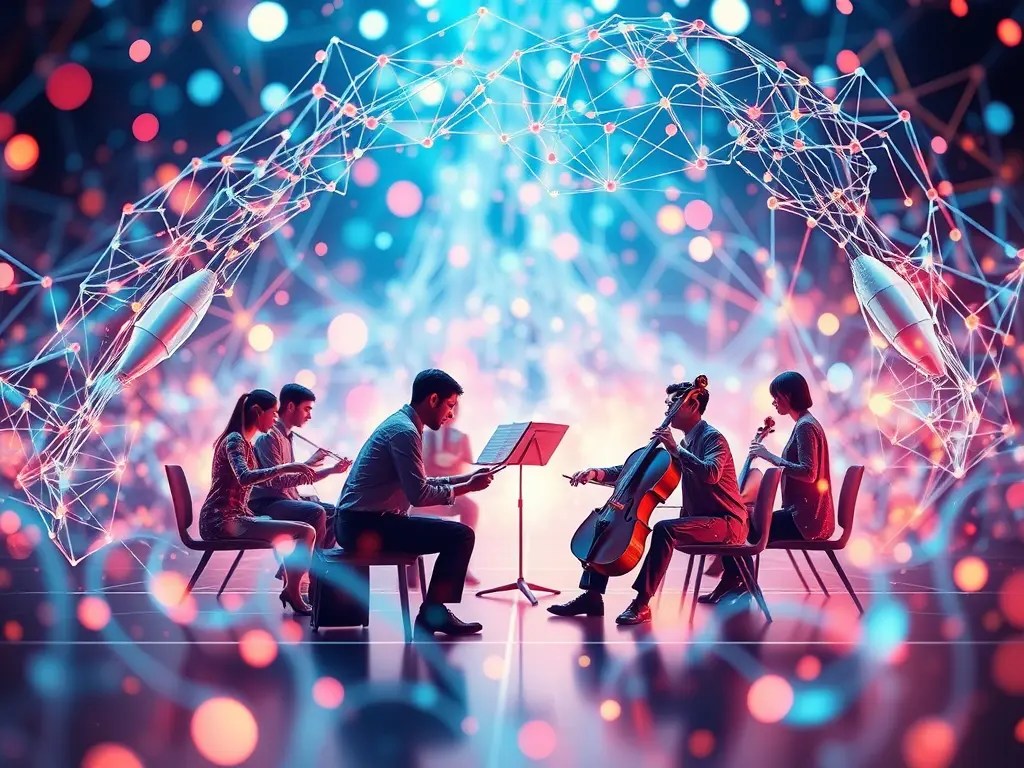
Multimodal AI isn’t just about processing different types of data—it’s about synthesizing information from multiple channels to create a richer, more context-aware understanding. Imagine a conversation where not only words but also facial expressions, tone of voice, and even subtle body language are all captured simultaneously. In the digital realm, multimodal systems replicate this phenomenon by combining text, images, audio, and sensor data to arrive at decisions or generate responses that mirror human-like perception. This combination creates a synergy where the whole is far greater than the sum of its parts.
Architectural Foundations
At the core of multimodal systems lie advanced deep-learning models designed to process varied data streams. Consider how these systems work:
- Parallel Data Processing:
- Individual Feature Extraction: Each modality—be it text, image, or sound—first travels through specialized neural networks. For images, convolutional neural networks (CNNs) are often deployed to extract spatial hierarchies of features. For text, transformer-based models that leverage self-attention mechanisms capture semantic nuance, while recurrent neural networks (RNNs) or transformers also handle temporal dependencies in audio.
- Representation Learning: Each network learns a latent representation or embedding that captures the essence of its input modality. These embeddings are vector representations where similar inputs yield closer vectors in high-dimensional space.
- Fusion Mechanisms: Once individual modalities are transformed into their respective embeddings, the challenge becomes merging them. There are several approaches:
- Early Fusion: Inputs are combined at the raw feature level, which can be useful when modalities are naturally aligned. However, this requires synchronization and can be sensitive to noise in one channel.
- Late Fusion: Predictions or features are combined after individual processing. This method allows each modality to contribute independently before a higher-level decision is made.
- Hybrid Fusion: A blend of both, wherein partial integration occurs at multiple stages. Attention-based fusion layers have emerged as a powerful technique here. These layers dynamically weigh the importance of each modality, allowing the model to “focus” on the most informative cues, much like a conductor emphasizes different sections of an orchestra.
- Feedback and Iteration: Modern architectures often incorporate feedback loops. For example, an initial conclusion drawn from a text and image combination might be refined by integrating audio data, with recurrent mechanisms or iterative transformers helping the model re-assess its outputs until it converges on a holistic interpretation.
Practical Applications and Innovations
The real power of these multimodal systems shows up in concrete, everyday applications:
- Autonomous Vehicles: Vehicles equipped with multimodal sensors (lidar, cameras, radar, and even audio sensors) can create an intricate model of their environment, detecting obstacles with higher accuracy by synthesizing disparate data points.
- Healthcare Diagnostics: In a clinical setting, patient data isn’t limited to lab reports. It includes radiology images, written notes, and even physiological signals. Multimodal AI systems integrate all these inputs, offering deeper insights that can lead to more accurate diagnoses and personalized treatment plans.
- Augmented Reality (AR) and Virtual Reality (VR): Immersive technologies benefit hugely from multimodal inputs—combining visual graphics, spatial audio, haptic feedback, and user interactions—to create environments that are both interactive and adaptive. This convergence is paving the way for experiences where digital content dynamically responds to real-world contexts.
- Creative Industries: AI-driven creative tools now blend textual storytelling with image generation and musical composition. For instance, a user’s written script can be accompanied by automatically generated visuals and soundtracks, each element analyzed and enhanced based on the others.
Challenges and the Road Ahead
While the promise of multimodal AI is immense, it comes with several challenges:
- Synchronization and Alignment: Aligning diverse data streams in time and context is a major hurdle. For instance, matching speech patterns with corresponding facial expressions in a video requires precise time-stamping and context mapping.
- Computational Complexity: The fusion of high-dimensional data requires enormous computational resources. Optimizing models to run on edge devices while maintaining accuracy is an ongoing research and engineering challenge.
- Bias and Misinterpretation: When merging data from various sources, the risk of compounding biases increases. Each modality might introduce its own noise and bias, and ensuring that the final fused representation is fair and unbiased requires rigorous testing and continuous calibration.
- Scalability and Real-Time Processing: For applications like autonomous driving or live AR systems, the integration must happen in real time. This means models must be not only accurate but also lightning-fast—balancing speed with sophistication remains a critical area of development.
Looking Toward the Future
Imagine a future where AI systems don’t merely process data—they understand experiences. By harnessing the power of multimodal inputs, the next generation of AI could lead to innovations such as:
- Emotionally Intelligent Machines: Systems that not only detect human emotions through voice and facial expressions but also adapt interactions accordingly, creating personalized and empathetic responses.
- Context-Aware Environments: From smart cities to intelligent workspaces, environments that respond to the collective inputs of numerous sensors, offering seamless automation and enhanced safety.
- Revolutionary Creative Collaborations: Tools that empower artists, writers, and musicians by integrating various sensory outputs, resulting in creations that are as dynamic as they are beautiful.
In essence, the multimodal revolution embodies a symphonic convergence of data—a harmonious blend where every input plays its part to produce richer, smarter outcomes. This intricate interplay not only enhances our understanding of complex systems but also drives innovation across a multitude of industries, from healthcare to entertainment. As we delve deeper into this transformative era, we witness the emergence of powerful AI algorithms that can analyze vast amounts of information from diverse sources, including text, images, and sound. This capability allows for more nuanced insights, creating opportunities for personalized medicine tailored to individual patients, while in entertainment, it fosters immersive experiences that blend storytelling with user interaction. Moreover, the ability to synthesize various data forms leads to more effective problem-solving techniques, enabling businesses to adapt swiftly to market changes and consumer demands, ultimately paving the way for an interconnected future where technology and human creativity flourish side by side.
 Ignite and Achieve