
Metaverse Learning
Education has always been shaped by the tools of its time—from chalkboards to laptops, each innovation has redefined how knowledge is shared. In 2026, the metaverse stands at the frontier of this transformation, offering unprecedented opportunities for interactive and experiential learning. No longer confined to classrooms or screens, students now step into immersive worlds where history is walked, science is experimented, and collaboration transcends borders, allowing learners to engage with content in a way that transcends traditional methods.
In this rich digital landscape, students can work alongside virtual peers from diverse backgrounds, tackling real-world problems and fostering a sense of global citizenship. Metaverse learning is not just a technological upgrade—it is a reimagining of pedagogy itself, blending virtual reality, artificial intelligence, and global connectivity to create an education system that is as dynamic and adaptive as the world it prepares us for. This evolution encourages creativity and critical thinking, equipping students with the skills necessary to thrive in an increasingly complex society, where knowledge acquisition is a continuous, collaborative journey rather than a mere consumption of information.
🌐 Core Dimensions of Metaverse Learning
- Immersive Classrooms: Students attend engaging lectures in dynamic 3D environments, interacting as avatars within rich, immersive settings. Geography no longer limits access to educational resources—global collaboration becomes the norm as learners from different continents come together to share knowledge and experiences. This advanced approach to learning not only enhances understanding but also fosters a sense of community among diverse student populations, allowing for a more enriched learning experience.
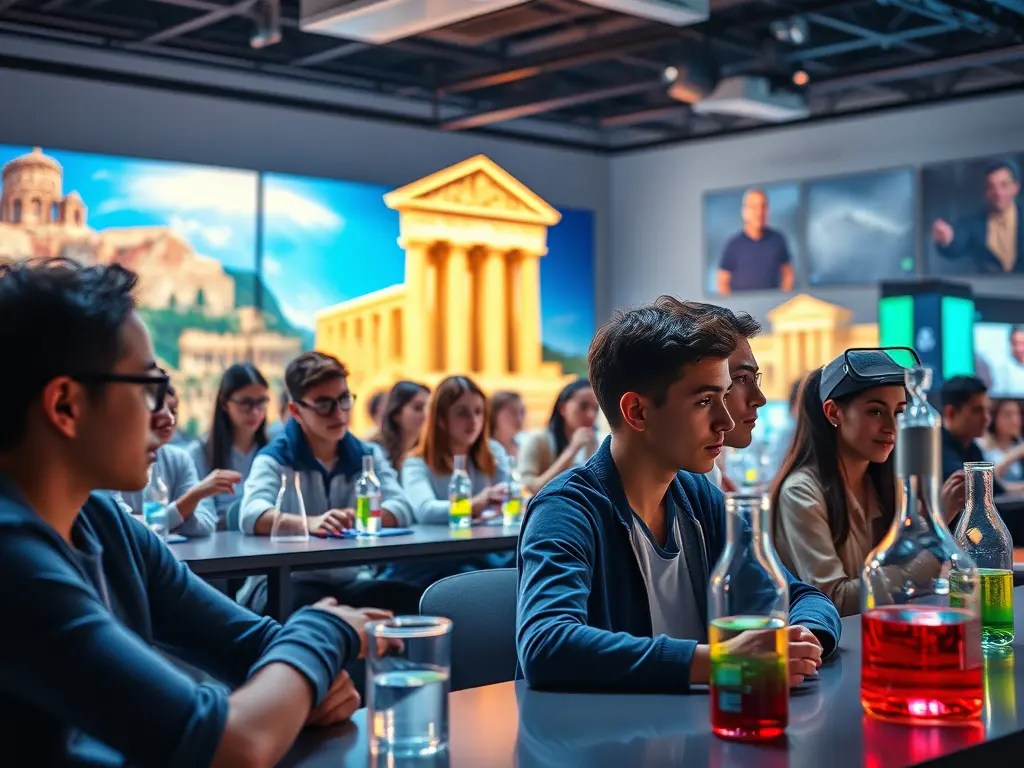
- Experiential Learning: Instead of merely reading about ancient civilizations in textbooks, learners can walk through Rome in 100 AD and immerse themselves in the daily life and culture of that time, or conduct chemistry experiments in a risk-free virtual lab, allowing for hands-on experience that enhances understanding and retention of complex scientific concepts.
- Gamification: Lessons are structured as quests, challenges, or simulations, making assessments more engaging, less stressful, and allowing students to actively participate in their learning by enhancing motivation and retention of knowledge through interactive elements.
- Multimodal Access: Voice, gesture, and text interfaces ensure inclusivity for students with disabilities or different learning preferences. This flexibility allows educators to cater to a diverse range of needs, enabling every student to engage meaningfully with the content and participate fully in the learning experience. By integrating these modes of interaction, we create a more adaptable educational environment that recognizes and values the unique strengths of each learner.
🎓 Pedagogical Innovations
- Scenario-based learning: Law students argue complex cases in virtual courts, honing their analytical and advocacy skills; medical students practice intricate surgeries in simulated hospitals, gaining hands-on experience in a risk-free environment while developing critical thinking and procedural expertise.
- Collaborative projects: Teams from different countries build models, solve problems, or design experiments together in shared metaverse spaces, fostering innovation through diverse perspectives and leveraging advanced technologies to enhance the collaborative experience, ultimately leading to breakthroughs that might not be possible in isolated environments.
- Adaptive pathways: AI tracks progress and adjusts the difficulty of simulations, ensuring students are challenged but not overwhelmed. This personalized approach allows for a tailored learning experience that recognizes individual strengths and weaknesses, fostering a more effective and engaging educational environment for every learner involved.
💡 Technological Foundations
- VR/AR hardware: Lightweight headsets, haptic gloves, and spatial audio create realistic immersion, enhancing user experience through intuitive interactions, seamless integration of digital elements into the real world, and providing an expansive range of applications from gaming to professional training.
- AI integration: In the ever-evolving landscape of education, autonomous tutors embedded in the metaverse guide students through interactive experiences, answer questions with immediacy, and personalize content based on individual learning styles and preferences, ultimately enhancing the overall educational experience.
- Blockchain credentials: Degrees, certificates, and achievements are stored securely as verifiable digital assets, ensuring their authenticity and preventing any possibility of fraud, while also providing easy access for users to showcase their qualifications in a transparent and immutable manner.
- Interoperability: Platforms are increasingly moving toward standards that allow students to carry their “learning avatars” seamlessly across institutions, thereby enhancing their educational experience and fostering greater collaboration.
📊 Benefits
- Engagement: Students report higher motivation and greater enthusiasm for learning compared to traditional e-learning, leading to a more dynamic and interactive educational experience.
- Retention: Experiential simulations improve memory recall by an impressive range of up to 30–40%, significantly enhancing learning outcomes and retention rates in educational settings.
- Access: Remote learners access a variety of opportunities, although these are often limited to physical labs, interactive simulations, or educational field trips, which can enhance their learning experience significantly.
- Scalability: Institutions can effectively host thousands of learners in shared environments without physical constraints, allowing for a seamless educational experience that accommodates diverse learning needs and preferences across various disciplines.
⚠️ Challenges
- Equity gap: VR hardware and high-speed internet remain expensive, risking exclusion of underfunded schools, which could further widen the educational disparities that already exist, leaving many students without access to cutting-edge learning tools that are increasingly becoming essential for a comprehensive education.
- Data privacy: Metaverse platforms collect vast amounts of behavioral data from users—raising significant ethical concerns regarding how this data is stored, used, and shared, as well as the potential for misuse and the implications for user consent and privacy protection.
- Teacher adaptation: Educators need extensive training to effectively design, manage, and implement immersive lessons that engage students and enhance their learning experiences.
- Over-immersion: Balancing screen time and real-world interaction is critical for student well-being, as excessive time spent on screens can lead to social isolation, decreased physical activity, and impaired cognitive development. Implementing strategies to encourage more face-to-face interactions and outdoor activities can significantly benefit students’ overall mental and emotional health.
🔮 Future Outlook (towards 2030)
- Global campuses: Universities may merge into shared metaverse hubs, offering joint degrees that allow students from different regions to collaborate in real-time on academic projects, enhancing cross-cultural understanding and global networking opportunities.
- AI-driven creativity: Tutors not only teach but actively co-create innovative projects with students, fostering an environment where collaboration and imagination thrive, leading to unique outcomes that reflect both the instructor’s expertise and the student’s vision.
- Neuroadaptive learning: Brain-computer interfaces could dynamically adjust lessons in an intelligent manner based on real-time cognitive load measurements, providing personalized educational experiences tailored to each learner’s needs and abilities.
- Hybrid models: Blending physical classrooms with metaverse overlays—students in a lab might see augmented molecular structures floating above their desks, enhancing their understanding of complex concepts through interactive visualizations and providing an immersive learning experience that bridges the gap between theoretical knowledge and practical application in real-time scenarios.

 Ignite and Achieve